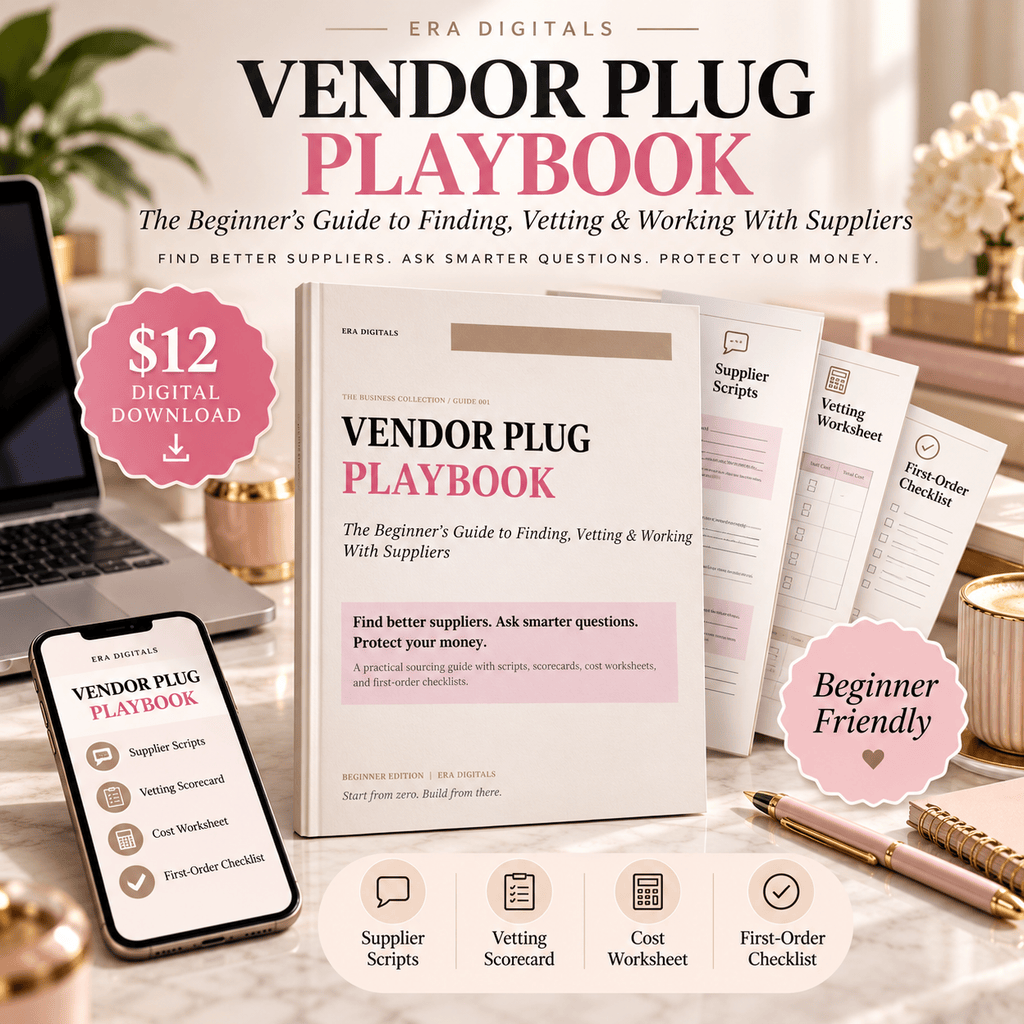
A note before we start: I own Era Digitals, the business behind the Vendor Plug Playbook featured in this article. If you purchase it, you are buying from my business.
You have a product idea, a few saved photos, and a vision for how your shop could look. Then you reach the question that makes everything feel a little more real: where do you actually get the products?
A supplier’s page can look polished without answering the things you need to know before ordering. Price matters, but so do the product details, order requirements, communication, and what happens if something arrives wrong.
Before putting money into inventory, give yourself time to compare the details. These questions can help you organize that research.
First, get clear about the product you want
Write down the item, materials, size, color, packaging, and quantity you are considering. If you want custom branding, say so at the beginning. A quote for a plain item is not necessarily a quote for that same item with a logo and custom packaging.
Being specific makes comparisons more useful. Otherwise, the cheapest option may simply be quoting something different.
1. Ask what the quoted price includes
Start with the unit price, then ask about anything that could change it. Customization, packaging, sample fees, shipping, and order quantity may affect the quote. Request a written breakdown rather than trying to reconstruct the total from several messages.
- What exact product and specification is this quote for?
- Does the price include the packaging shown?
- Are customization or setup fees separate?
- How long is the quote valid?
- What additional charges should I budget for?
2. Understand the minimum order quantity
MOQ means minimum order quantity. Ask whether it applies to the whole order, each item, each color, or each size. A minimum that sounds manageable can become a much larger purchase if every variation has its own requirement.
Compare that minimum with what you can realistically store, afford, and test. Being offered a lower unit price on a large order does not make that order the right choice for your business.
3. Find out how samples work
Ask whether a sample is available, what it costs, and how long it takes to receive. Clarify whether it represents the exact product you are considering or a general example. If you need custom work, ask what will differ between the sample and the finished order.
Keep notes about the details that matter for your product: finish, construction, color, sizing, packaging, and consistency with the description. A sample is one piece of information. It cannot guarantee that a later shipment will be identical.
4. Separate production time from shipping time
Ask when production begins, what the estimated production window covers, and what shipping estimate follows it. Check whether a quoted timeline starts after payment, after artwork approval, or after another step.
Leave yourself room for uncertainty before announcing a launch date. A supplier’s estimate is useful planning information, not something to promise customers as a certainty.
5. Ask what happens when there is a problem
Before ordering, request the process for damaged items, incorrect specifications, missing quantities, or other issues. Ask what evidence is needed and whether there is a deadline for reporting a problem.
Read the written terms and keep your order details, approvals, invoices, and messages together. If a policy is unclear, ask before paying. Do not fill the gaps with the answer you hope the supplier means.
6. Notice how the supplier communicates
Look for answers that address your actual questions. If you ask about materials and receive only a payment request, follow up. If the answer changes, ask for clarification in writing.
Fast responses alone do not prove a supplier is reliable, and a busy supplier is not automatically a bad one. What matters is whether you can get clear, consistent information before making a decision.
7. Compare total costs, not just the item price
Make a list of the costs you expect to pay before the product is ready to sell. That might include inventory, samples, packaging, delivery, and other charges specific to your order. Include selling costs when considering what a possible sale would leave.
A simple example: a small order with a higher unit price may let you test demand with less money committed. A larger order may lower the unit price while leaving you with more stock to store and sell. Neither option is automatically better. Compare the whole commitment.
A vendor comparison you can start today
- Product and specifications quoted.
- Minimum order quantity and variation rules.
- Sample availability, cost, and timing.
- Item, packaging, customization, and delivery charges.
- Production and shipping estimates.
- Written process for problems.
- Questions that are still unanswered.
Use the same headings for each supplier. Mark missing information as unanswered instead of guessing. Keep looking if you cannot get the details you need to make a comfortable decision.
Want a more organized starting point?
The Vendor Plug Playbook from Era Digitals is a beginner-friendly digital guide for finding, comparing, and checking suppliers before preparing a first order. It is $12 USD at the time this article is published.
The product includes:
- Copy-and-paste vendor messages.
- Vendor comparison worksheets.
- Research trackers.
- Sample and first-order checklists.
- Scam red flags to watch for.
- Guidance on MOQ, costs, and preparing an order.
This is not simply a list of vendor names. Its focus is helping you learn a research process you can use as your business develops.
The playbook is a digital PDF download. No physical book or product is shipped. It is for educational and personal use; results, supplier quality, pricing, and business success are not guaranteed. Check the product page for the current price and purchase details.
Research before the excitement becomes an order
Starting a product business can be exciting. You are allowed to enjoy that part and still take your time with the numbers, the samples, and the questions. Getting clearer about an order before you place it is a useful step, even if you decide not to buy yet.
What part of finding a vendor feels most confusing right now: where to look, what to ask, or how to compare the quotes?


Leave a Reply